
Cash Resilience: the Infrastructure Question Behind the Future of Payments


The importance of cash is growing as its role as a resilience asset, a financial inclusion mechanism and a contingency payment method is increasingly recognised. It is against this background that the International Association of Currency Affairs (IACA) has spent 18 months on a series of events exploring the future of key cash stakeholders [1].
On the surface things look good because, around the world, cash in circulation is growing between 2% and 5% annually by volume. At the same time the volume of digital payments is also climbing quickly. However cash transactional demand is often falling and that compresses the economies of the infrastructure that prints, moves, authenticates, and distributes cash.
And that’s the dilemma. At a policy level, cash is increasingly important but day to day in many places, cash usage is changing or even falling.
Four stakeholders, one shared pressure
The IACA series examined the issue through four stakeholder groups: banknote printers, central banks and issuing authorities, commercial banks, and cash management or cash-in-transit (CIT) operators. Their incentives differ sharply, but their concerns converge.
Banknote printers are facing unpredictable order books, compressed margins for R&D, and procurement relationships that simultaneously ask for lower unit costs and better security. The industry is capital intensive and skills dependent; uncertainty makes long-term investment harder just when resilience requires it.
Central banks and issuing authorities carry public responsibility for confidence, quality and circulation, but in many markets, they do not directly control the infrastructure on which those outcomes depend. Outsourcing can bring efficiency, but excessive distance from operations weakens visibility, expertise and intervention capacity.
Commercial banks are increasingly being required, sometimes by law, to maintain access to cash. At the same time, lower branch and ATM volumes make that infrastructure less attractive commercially. The result is a widening gap between public obligation and private incentive.
Cash management companies and CIT operators are the most commercially exposed stakeholder. They carry the fixed costs of secure transport, vaults, staff and contingency capacity, while revenues fall with transaction volumes.
Australia’s emergency intervention to prevent sector collapse has become a warning: when the cash logistics base becomes uneconomic, access failure can arrive suddenly.
Shared challenges
Across all four stakeholders, five themes emerge.
- There is a risk that the commercial viability of the cash cycle may disappear before the public’s need for cash does. Part of that challenge is that no stakeholder group can see another’s breaking point because each is calculating the viability of their own particular cost base. If action is going to be needed to safeguard the cash cycle, it needs to happen before the crisis.
- The drive for efficiency, individually rational in every part of the cycle, is potentially eroding the redundancy that resilience depends on.
- The cash ecosystem has no single owner. Central banks carry the mandate for resilience without the means to compel commercial actors who deliver it.
- Voluntary action has not resulted in the cash cycle being safeguarded. Regulation has been the deciding factor in every case of infrastructure being preserved. As a result, the question today is not whether central banks and governments should take a position on cash, but how actively to do so.
- In some countries cash is increasingly seen as a resilience asset rather than a payment tool. As digital dependency deepens, this role of and for cash is increasingly important.
The report identifies seven specific systemic risks, but they are linked by a key question: who pays for the regulatory floor that cash provides as the backstop that underpins any failure in digital payments and the provision of societal contingency needs (financial inclusion, privacy etc.)?
As the economics of the cash cycle begin to fail, somebody has to pay. The report highlights that digital payment operators and fintechs who benefit from cash’s existence as a backdrop don’t contribute to the costs of sustaining it.
Understanding the future of cash cycle
A number of themes emerged which cut across all stakeholders:
The critical threshold for cash availability
At what point does declining volume make cash infrastructure economically unviable? The answer will vary by country, and each stakeholder will have its own answer. The risk is that commercial viability disappears before the public need. No stakeholder group has visibility into another’s breaking point.
Striving for efficiency is undermining resilience
Every stakeholder group may optimise for cost efficiency, but the cumulative effect of individually rational decisions may be a system which, although leaner, is also more fragile.
Governance fragmentation across the cash ecosystem
Although central banks ultimately carry responsibility for currency in circulation and public confidence in cash, no one actor in the cash cycle is accountable for cash end to end. Central banks do not control the infrastructure directly through which cash reaches the public and so they cannot compel cash stakeholders to act. They carry the mandate without the means.
The regulation question
Should central banks remain neutral between payment methods? Several participants across the series argued that the question is already settled in practice - central banks that actively promote digital payments, issue CBDC, or advocate for digital inclusion are not neutral.
Digital payment operators and fintechs benefit from cash’s existence as a contingency backstop without contributing to the cost of the infrastructure that makes it available. As digital payment dependency deepens, this free rider dynamic becomes more acute. The question is not whether to take a position on cash, but whether to take an active one.
Cash as resilience asset
A significant reframing of cash is emerging, with cash increasingly being viewed not simply as a transactional payment method but as a resilience asset, and as such, it has direct implications for every aspect of how the ecosystem is governed, funded, and regulated.
If cash is a resilience asset, then the cost of sustaining it cannot be justified solely on transactional economics, it must be justified on its value as a backstop. Infrastructure that is inefficient by transactional metrics may be essential by resilience metrics. The organizations responsible for funding it, the regulatory frameworks that protect it, and the governance structures that coordinate it all need to reflect the asset that cash actually is, not the payment tool it used to be.
Part of this is a comment on the damage done by regarding ‘cash as over’. It shapes investment decisions, puts off people joining the cash sector creating skills shortages and affects policy postures, potentially crowding out genuinely productive conversations about optimal cash cycle design, central bank monetary control, and resilient payment system architecture.
Systemic risks and cross-stakeholder vulnerabilities
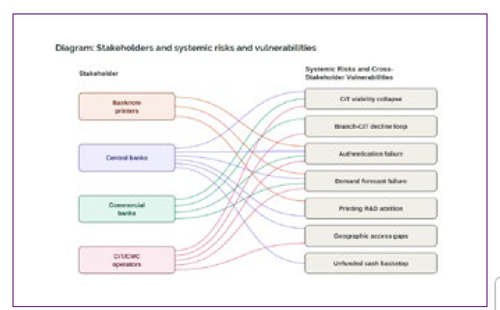
The paper identifies six risks/ vulnerabilities. It also shows a diagram linking stakeholders and those risks and vulnerabilities.
- CIT viability collapse leading to cash access failure
- Self-reinforcing branch and CIT decline spiral
- Authentication failure in commercial recirculation
- Demand forecasting failure under geopolitical shock
- R&D attrition in security printing
- Geographic access gaps and rural exclusion
Conclusion
The IACA series points to a simple conclusion with difficult consequences. If cash is to remain available when society needs it most, its infrastructure cannot be left to decline until an emergency exposes what has been lost. Resilience is not produced by sentiment, and it is rarely produced by uncoordinated efficiency. It requires deliberate design, visible accountability and a funding model that recognises the public value cash now provides.
The future of cash is therefore not principally a question of whether people will use it more or less tomorrow. It is whether cash as a payment systems will retain enough diversity, redundancy and trust to function when the preferred digital channels do not.
What’s next for IACA?
Building on the findings of the Future of Key Cash Stakeholders Focus Series, IACA’s next Focus Series, The Future of Cash Cycle Resilience, will consider how IACA can help members better
understand, assess and address resilience across different cash systems. Through member engagement and cross-stakeholder discussion, the Series will take a system-wide view of the factors that can affect the ability of the cash cycle to continue functioning effectively, with the aim of supporting greater resilience and coordination across the cash ecosystem.
1 - IACA summary report: Future of the key cash stakeholders focus series
Get the Cash & Payment News™ Weekly delivered free to your inbox.