
ATMIA Berlin Conference Highlights


This year the ATM Industry Association (ATMIA) ran its European and Emerging Markets event as a roadshow with one meeting in Madrid and another in Berlin in the same week at the start of June. We report here on three presentations from the conference – an overview of Germany, a report from the European Commission on progress with the Legal Tender Cash Regulation, and a detailed report from Piraeus Bank about what is happening to cash in Greece.
Cash in Germany: access and acceptance
Dr Jelena Stapf, Head of Department of the Directorate, General Cash Management at the Deutsche Bundesbank, kicked off with a striking early phrase that the central bank is ‘not just selling a product but selling an idea’.
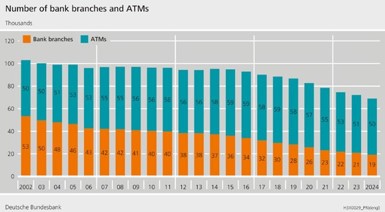
Access to cash: the main source of cash in Germany, bank-based cash infrastructure, has been in steady decline for many years. While the number of ATMs rose from 50,000 in 2002, peaking at 59,000 and remaining at that level until 2018, in 2024 it was back down to 50,000. However, there were 53,000 bank branches in 2002 but that has fallen every year, reaching 19,000 in 2024. The decline has accelerated since 2015.
The distribution of bank branches and ATMs also needs consideration. While the overall figure shows that 95.7% of people have easy access to bank branches or an ATM (80.7 million people), 3.9% do not have cash infrastructure (3.3 million) within a reasonable distance. As one would expect, urban areas have better access than rural regions.
Whatever the data: the perception is that access to cash is getting more difficult. In rural areas the number of people who thought access to cash through ATMs and bank counters was fairly or very difficult increased from 6% to 15%. In urban areas the figures were virtually identical. The 2025 data was published after the conference and those finding cash hard to get rose to 17% (and 18% in urban areas).
Acceptance of cash: the survey results found that 98.7% of people could pay in cash straightaway, and that this figure was fairly consistent across all economic sectors. Interestingly the image of shops that do not accept cash is of being more modern and youth-oriented.
The Bundesbank has innovated by using mystery shoppers to explore cash acceptance. The first trial only used a very small number of shoppers on limited circumstances. A more substantial trial is planned.
In the discussion the point was made that voluntary agreements for access and acceptance are seldom enough. This has been the case in the Netherlands and Latvia. Also that access and resilience are not the same thing. Utility models may leave people within the target time and distance to accessing cash, but when there is a problem, there isn’t enough cash.
Euro cash today and tomorrow: access, acceptance and trust
Christos Metaxas, Legal and Policy Officer at the Directorate General ECFIN, explained what is being done to safeguard the euro by the work of the European Commission (EC), European Parliament (EP) and the Council of Europe.
In 2025 the value of euro banknotes in circulation reached €1.6 trillion and for coins, €35.4 billion. These are big numbers. In 2024 at the point-of-sale (POS) they equated to 39% of the value of transactions and 52% of the number of transactions that took place. However, surveys show that access to cash is getting worse in Germany, Estonia, Finland and Italy. Given that 62% of Europeans think it important to have the option to pay in cash, this is important.
Legal Tender Cash Regulation: the European Commission (EC) has been looking at the Legal Tender Cash Regulation (LTCR) and has established three principles:
- The mandatory acceptance of cash
- At full face value
- With the power to discharge from a payment obligation.
This means European Union (EU) member states must ensure access to cash has to be sufficient and effective in all regions. If a member state considers, on the basis of its monitoring and assessment, that the acceptance of payments in cash is undermined by widespread and structural refusals of cash payments, it shall set out the remedial measures.
One proposal is to limit cash payments to €10,000 but with individual member states being allowed to set a lower limit if they choose to. This is an example of the LTCR being flexible but binding.
To date the EC has made a proposal and the general approach has been agreed by the Council of the European Union. Currently the EP is negotiating a mandate. This will then go to what is known as the ‘trilogies’ for inter-institutional negotiations (EC, EP, and the Council of the European Union). Only then is it adopted and enters into force.
Simplification and ‘stress-testing’: the EU has faced considerable criticism that its legislation has stifled Europe’s economic energy and innovation. It is currently reviewing and revising legislation to reduce the burden. To date it had made administrative savings of €15 billion and has a target of achieving €37.5 billion by 2029.
In the context of legislation on euro cash this has led to the stress testing this year of the 2012 regulation on the issuance of euro coins and the 2014 regulation on the denominations and technical specifications of euro coins intended for circulation.
In 2027 the 2011 regulation on the professional cross-border transport of euro cash by road between member states and the 2010 regulation concerning the authentication of euro coins and handling of euro coins unfit for circulation will be reviewed.
In 2028 the 2001 regulations laying down measures necessary for the protection of the euro against counterfeiting and the 2004 regulation concerning medals and tokens similar to euro coins will be reviewed.
Piraeus Bank: Future proof cash management strategy and the ATM’s role
Sofia Beneka explained what is happening to cash in Greece and how Piraeus Bank is addressing a fast changing cash scene. Although this was a master class in managing change, the final conclusion was sobering: high fixed costs make falling volumes unsustainable.
Cash in Greece: Greece now uses only slightly more cash than the EU average, but the trend is down. One outlying area is that 36% of Greeks receive a significant share of their regular income in cash. The EU average is 14%.
Cash matters in Greece for four reasons:
- Culturally, cash plays a central role. Greece also has a lot of small businesses.
- Tourism is a big driver of cash use, particularly in the islands and remote areas. Seasonal businesses also prefer cash.
- Greece has experienced a number of crises and the public sees cash as a secure store of value and fallback payment method.
- In parts of the economy, a share of income is paid in cash, which can make under-reporting easier and contribute to tax evasion.
A series of events have played a key role in creating a structural shift in cash and ATM usage. In 2010 Greece experienced an economic crisis and the number of bank branches started to fall. In 2013 there were 2,886. By 2022 there were 1,353 and the number has continued to fall since then. In 2025 there were 54% fewer bank branches than in 2013.
Greece now has 60 ATMs per 100,000 people, compared with 71 for the Euro area and 66 for the EU’s 27 members. These are bank ATMs and this does not include independent ATM deployers (IAD). Piraeus manages 29% of Greece’s bank ATMs, down from 34% in 2024, but accounts for 40% of ATM cash transactions value.
In 2015 capital controls were introduced and this drove a surge in card payments. In 2017 electronic POS systems were mandated and the terminal infrastructure expanded nationwide. In 2019 the government introduced tax incentives to encourage electronic payments. Again, usage surged. In 2020 COVID hit.
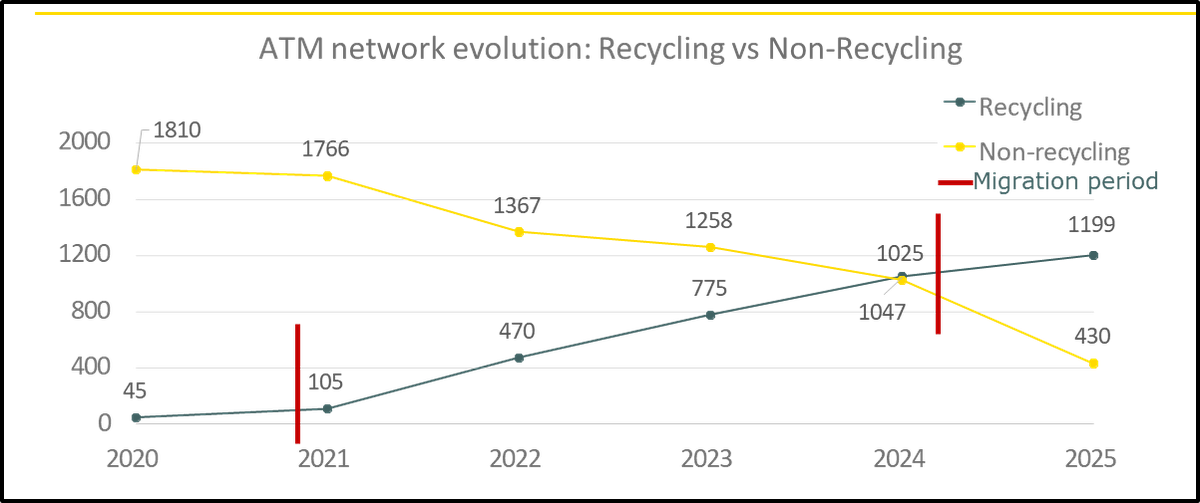
ATM market evolution: the value of ATM cash transactions and withdrawals has grown steadily, benefiting from the reduction in bank branches. Interestingly, ATM cash deposits have grown faster than cash withdrawals since 2021. In 2020 there were 45 recycling ATMs, by 2025 there were 1,199. The number of non-recycling ATMs has fallen from 1,810 to 430. While withdrawals increased by 9% between 2021 and 2025, deposits grew by 56%.
This is particularly true for Piraeus which has seen withdrawals and deposits grow from 32% each in 2021 to 34% and 49% respectively by 2025. This is because Piraeus has invested heavily in deposit taking machines.
Challenges driving changes at Piraeus: Piraeus found itself faced by:
- High operational costs due to having to make frequent and inefficient replenishments.
- Manual and fragmented processes, with ATM decisions made on ‘experience’ and with no centralised or automated workflow.
- Inefficient reconciliation driven by having to make 10,000 manual reconciliations per month and with no way to scale this time-consuming and labour intensive operation.
- Lack of transparency, with no audit trail for replenishment decision and reconciliation activities.
- Weak controls since the four-eyes principle was not used.
The solutions adopted were to:
- Invest in recycling ATMs to reduce replenishment frequency.
- Use artificial intelligence in cash demand forecasting, to allow data-driven decision making and to automate ATM replenishment protocols.
- Automated reconciliation of all ATM cash cycles and use exception-based handling, ie. only focusing on discrepancies.
- Move to embedded approval workflows which have full transparency and auditability, being based on built-in four-eyes workflows and role-based access and approvals.
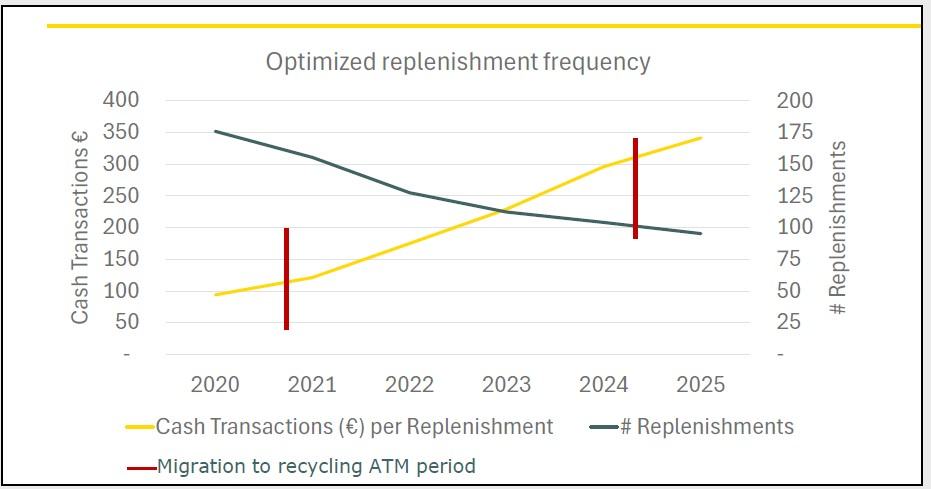
The number of cash transactions per replenishments has increased by 263% since 2020. The number of ATM replenishments has fallen by 46%. In addition, bank branch staff got back 180,000 working hours by having fewer on-site ATM replenishments each year.24,000 fewer off-site ATM replenishments saved cash-in-transit (CIT) costs and 170 tonnes of CIT-generated CO₂.
Facing the future: high fixed costs – CIT, maintenance, energy, and ATM site rents –are driving up the cost per transaction. Inflation also pushes costs up, straining ATM profitability. At the same time, lower volumes are causing a revenue-cost gap which is unsustainable. mean higher costs and squeezed profits. The way ahead is unclear.
Get the Cash & Payment News™ Weekly delivered free to your inbox.